命中注定我爱你
Vessel tests begin along China's major river-to-sea Pinglu Canal_我的网站

A | Nearly half of all injuries reported from electric bikes in the last six years took place in 2022, according to a new report from the Consumer Product Safety Commission (CPSC).The CPSC estimates more than 360,000 injuries related to micromobility devices were treated in emergency rooms across the country between 2017 to 2022.According to the report, injuries rose more than 20% in 2022, compared to the year prior.There have been at least 233 deaths associated with e-bikes, e-scooters and hoverboards from 2017 through 2022, the report said. CPSC acknowledged that reporting on deaths associated with the devices is "ongoing and incomplete."This comes as sales and usage of e-bikes, e-scooters and hoverboards are on the rise, according to the market research firm Circana, the U.S. e-bike market grew 269% between 2019 and 2022, with $885.5 million in sales last year.CPSC's report also highlighted "significant" fire hazards from the devices – CPSC said it was aware of at least 19 deaths associated with micromobility device fires from 2021 through late November 2022.Last year, CPSC called on more than 2,000 manufacturers and distributors of the devices to review their product lines and ensure they comply with voluntary safety standards "to reduce the serious risk of dangerous fires with these products."CPSC also "urged" consumers to take steps to prevent fires from e-bikes, e-scooters, and hoverboards by always being present when charging the devices and only using approved battery replacements.ABC News' Meredith Deliso contributed to this report.。
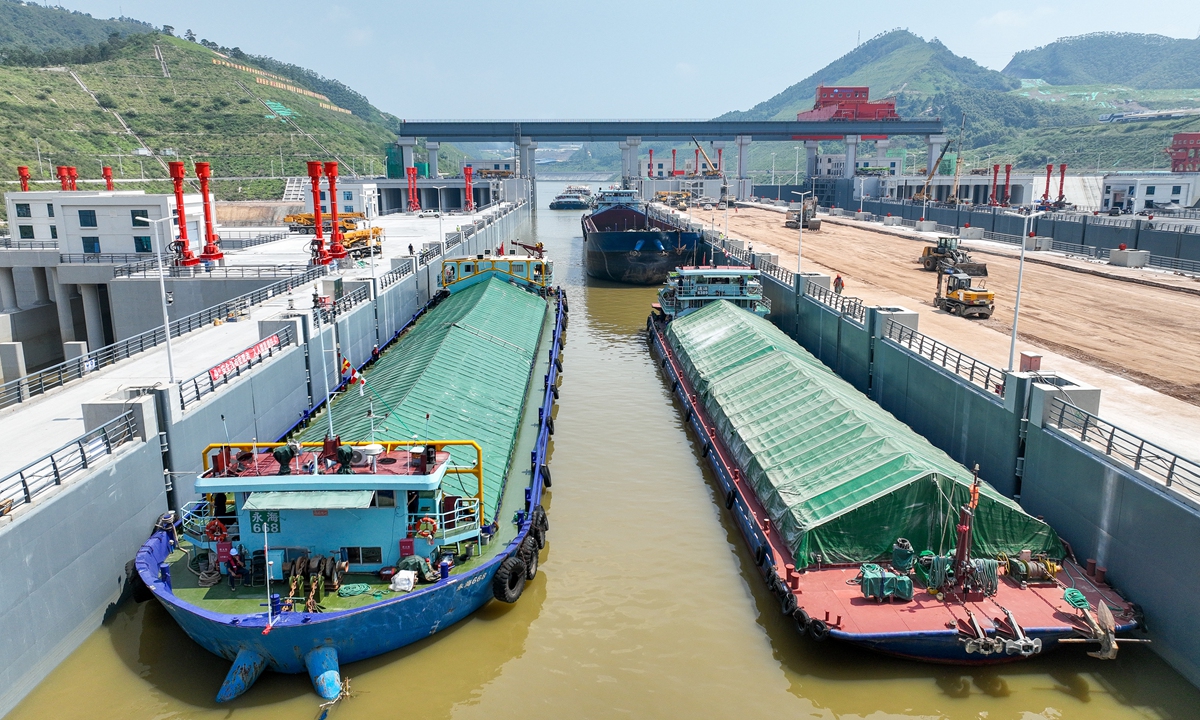
Vessels enter a ship lock of the Pinglu Canal in Lingshan county, Qinzhou, South China's Guangxi Zhuang Autonomous Region on August 12, 2026.
Equipped with China's homegrown BeiDou positioning systems, drones and sensors, four vessels began trial runs along China's Pinglu Canal on Wednesday. The canal, which is planned for opening in September, will greatly inject economic vitality to areas along its route and turbocharge China's trade connection with the ASEAN with its cost-saving transportation, a Chinese analyst said.
The vessels conducting trials on Wednesday represent the main types expected to sail on this canal, namely loaded and unloaded 5,000-tonne ships as well as loaded 3,000-tonne and 1,000-tonne vessels, Xinhua News Agency reported.
The trials began when an unloaded 5,000-ton vessel departed from the Xinfu service area along the canal in South China's Guangxi Zhuang Autonomous Region, the Xinhua News Agency reported.
With sensors collect data on their routes, movements, water currents and safe distances between ships, the tests will assess navigation under both normal and adverse conditions and examine whether the canal's waterways, locks, anchorages, service areas and navigation facilities are ready for operation.
Chinese analysts said the tests starting on Wednesday, days after the canal completed its first full-route patrol, indicated that the canal is one step closer to its scheduled opening in September as final preparation work ramp up.
Zheng Ping, chief analyst at industry news portal chineseport.cn, told the Global Times on Wednesday that as a major project in the nation's water network, the opening of the canal later this year will bring sea changes to areas along its route with fresh economic opportunities with its role as a low-cost enabler for domestic and international trade.
"Inland water traffic has great advantage in transportation capacity and costs. While a train can typically carry 20 40-foot container or more, a waterborne vessel can easily carry over 100 such containers. So a five-times capacity is gained here, greatly reducing transportation costs for goods," Zheng said.
For goods that are not time sensitive, or for bulk cargo such as coal, aluminum or fertilizers, waterborne traffic has unparallel advantage, the expert noted.
The 134.2-kilometer-long Pinglu Canal is a key project of the New International Land-Sea Trade Corridor. With total investment exceeding 70 billion yuan ($10.37 billion), the canal begins at the Pingtang River estuary in Hengzhou, administered by Nanning, follows the Qinjiang River into the Beibu Gulf, according to Xinhua News Agency.
It is China's first major river-to-sea canal project planned and coordinated at the national level since 1949 and is designed to accommodate vessels of up to 5,000 tons.
In addition to facilitating transportation, modern canal system will also have the function of water resource diversion, flood control and irrigation, greatly boosting up local economic development, Zheng said.
Lei Xiaohua, deputy director of the Institute of Southeast Asian Studies at the Guangxi Academy of Social Sciences in South China's Guangxi Zhuang Autonomous Region, told the Global Times on Wednesday that the Pinglu Canal will serve as a new engine for the deep integration of industrial chains between China and ASEAN.
"Raw materials from ASEAN can enter China's hinterland via the Beibu Gulf ports at lower costs, while Chinese exports including aluminum products and building materials can reach Southeast Asia more efficiently," Lei said.
Against the backdrop of deep industrial chain integration between China and Vietnam, the canal, which offers a low-cost, high-capacity transport route, is poised to foster new models of cross-border industrial capacity cooperation, said Lei.
When operational in September, the canal will give inland regions in Southwest China a more direct river route to the sea. Cargo that previously had to travel eastward through the Port of Guangzhou will be able to head south directly toward ports in the Beibu Gulf, shortening some inland waterway journeys by about 560 kilometers, according to Xinhua.
The New International Land-Sea Trade Corridor is an international trade and logistics network connecting China's western regions to ASEAN countries and other overseas markets.
The corridor has continued to record strong trade growth. During the first half of 2026, imports and exports transported through the corridor by its participating regions reached 517.23 billion yuan, up 13 percent year-on-year and setting a new record for the same period, per data released by Chongqing municipal government.
The corridor's rail service handled a record 1.425 million 20-foot equivalent units of cargo in 2025, up 47.6 percent year-on-year. As of early June of 2026, its network reached 593 ports in 128 countries and regions.
。
Current article:http://4zws.shangyaohujunwei.bond/uax/g2p7krg.html
Published on:22:24:15

 河北:盘活存量用地 激活发展动能
 【成长·传承】今日冬至
 【研报观点】8月26日氧化铝最新观点汇总
 插混动力/综合续航1360km 定价是关键!一文看懂新款沃尔沃XC60
 重要价格有了变化,出现哪些新机会?
 Salman Khan Meets Idris Elba in Jeddah, Shares His Take on Alia Bhatt's Big Honour
查看所有0条评论>>